

Nano-PTFE nickel mold enables defect-free micro molding
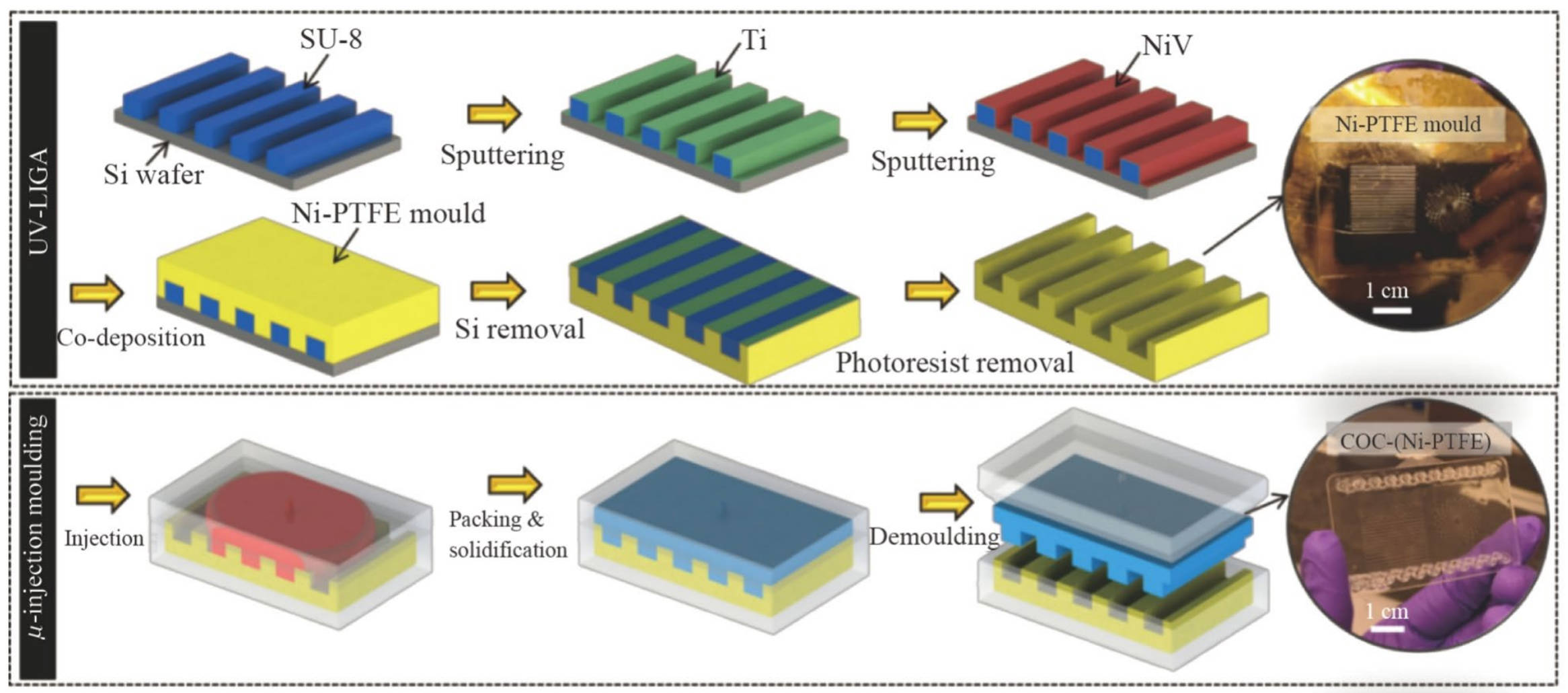
Schematic of the UV-LIGA process to develop a Ni-PTFE mold and its application in the micro injection molding process for producing COC chips.
GA, UNITED STATES, January 4, 2026 /EINPresswire.com/ -- Micro injection molding has become a cornerstone for mass-producing microfluidic devices, yet demolding defects and mold wear remain persistent challenges. This study introduces a nickel mold reinforced with nano-polytetrafluoroethylene (PTFE), designed to overcome adhesion and friction at the polymer–mold interface. By embedding PTFE nanoparticles through electrodeposition, the mold achieves enhanced hardness, reduced surface energy, and stable lubrication. Testing over 1,500 molding cycles demonstrated its ability to produce clean, defect-free polymer microstructures without contamination. The approach offers a cost-effective, durable, and biocompatible solution that could transform the scalable production of microfluidic chips and other polymeric micro-devices.
Microfluidic chips and polymeric microstructures are critical in diagnostics, drug delivery, and optical sensing. Conventional molds, often based on silicon or pure nickel, face limitations such as brittle fracture, high interfacial adhesion, and short service life. Additional coatings and release agents have been applied, but they risk altering dimensional accuracy, peeling, or contaminating polymer products. These issues compromise efficiency and increase costs. The growing demand for high-volume, disposable biomedical devices highlights the need for molds that inherently combine high precision, durability, and low adhesion. Based on these challenges, it is necessary to develop novel mold materials with stable lubrication and defect-free demolding performance.
Researchers from University College Dublin and Tianjin University reported (DOI: 10.1007/s40436-025-00568-7) their findings in Advances in Manufacturing on July 7, 2025. The team developed a high-performance nickel mold reinforced with nano-polytetrafluoroethylene (PTFE) fillers via electroforming. Unlike conventional nickel molds that require coatings or release agents, the new mold integrates lubricating nanoparticles directly into the matrix. Tested across thousands of micro-injection molding cycles, it consistently produced polymer microstructures without defects, contamination, or wear, offering a scalable pathway for producing microfluidic devices and other high-precision polymer components.
The new Ni-PTFE mold was fabricated by dispersing PTFE nanoparticles in a nickel sulfamate electrolyte and electrodepositing them with nickel onto a silicon master. Structural analysis confirmed uniform distribution of PTFE fillers without altering the crystal structure of nickel. The mold achieved a hardness of 452 HV, more than double that of pure nickel, and exhibited a reduced surface energy of 28.1 mJ/m²—a 33.6% decrease. These properties translated into a 28.6% reduction in demolding force. Performance testing with common polymers including cyclic-olefin-copolymer (COC), polypropylene (PP), and PMMA revealed defect-free replication of features as small as 30 µm at aspect ratios up to 3.3:1, maintained over 1,500 cycles. Importantly, no PTFE nanoparticle contamination was detected on polymer chips using Raman spectroscopy or EDS analysis. Biocompatibility tests with HEK293 cells showed no cytotoxicity, confirming safe application in biomedical devices. Compared to coated molds, which often require reapplication and degrade quickly, the Ni-PTFE mold maintained stable surface energy and tribological properties, ensuring durability and reliability for industrial use.
“Conventional nickel molds have long been constrained by adhesion and wear, often requiring costly and unreliable coatings,” said lead author Nan Zhang. “By embedding PTFE nanoparticles directly into the nickel matrix, we created a mold that is self-lubricating, wear-resistant, and capable of producing thousands of clean polymer microstructures. This innovation addresses the industry’s need for durable, contamination-free molds and represents a significant advance for microfluidic and biomedical manufacturing. The scalability and low added cost also make it attractive for industrial mass production.”
The Ni-PTFE nanocomposite mold offers a cost-effective and robust solution for high-volume manufacturing of microfluidic chips, lab-on-a-chip devices, and other polymer micro-components. Its ability to sustain more than 1,500 defect-free molding cycles without coatings or demolding agents significantly reduces production costs and downtime. The non-toxic, biocompatible polymer chips it produces are well suited for biomedical applications such as diagnostics, drug delivery, and organ-on-chip systems. Beyond healthcare, the mold could accelerate industrial production of micro-optics, sensors, and microneedles. With its scalability and durability, the Ni-PTFE mold lays a foundation for next-generation precision manufacturing.
DOI
10.1007/s40436-025-00568-7
Orignal Source URL
https://doi.org/10.1007/s40436-025-00568-7
Funding information
Open Access funding provided by the IReL Consortium.
Lucy Wang
BioDesign Research
email us here
Legal Disclaimer:
EIN Presswire provides this news content "as is" without warranty of any kind. We do not accept any responsibility or liability for the accuracy, content, images, videos, licenses, completeness, legality, or reliability of the information contained in this article. If you have any complaints or copyright issues related to this article, kindly contact the author above.
