

Latin America Diagnostic Imaging Market to Reach US$ 492.1M by 2031 at 7.1% CAGR | Expands with MRI, CT and AI Adoption
Latin America Diagnostic Imaging Market
Latin America Diagnostic Imaging Market to reach US$492.1 Million by 2031, driven by AI integration, chronic disease rise, and healthcare modernization.
AI-powered imaging and preventive healthcare reforms are reshaping Latin America’s diagnostic landscape, accelerating early detection & strengthening clinical precision across oncology and cardiology”
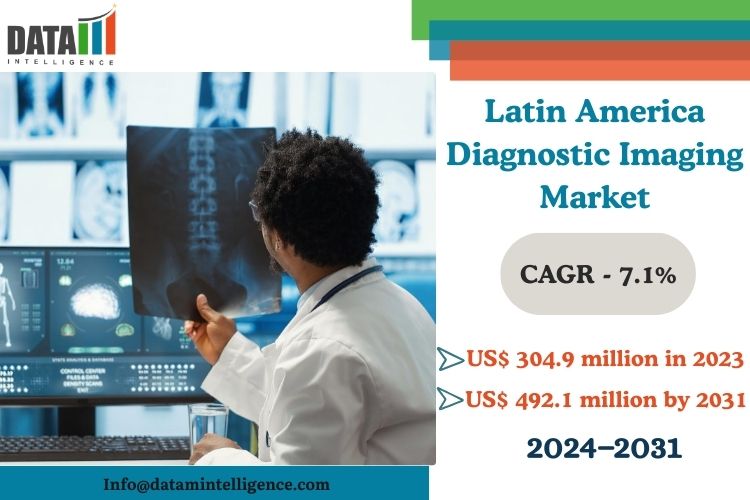
AUSTIN, TX, UNITED STATES, February 23, 2026 /EINPresswire.com/ -- The Latin America Diagnostic Imaging Market reached US$ 304.9 million in 2023 and is projected to reach US$ 492.1 million by 2031, growing at a CAGR of 7.1% during 2024–2031. The market is experiencing steady expansion driven by rising chronic disease prevalence, expanding private healthcare infrastructure, and increasing adoption of advanced imaging technologies across Brazil, Mexico, Argentina, Chile, and Colombia.— DataM Intelligence
Diagnostic imaging plays a central role in early disease detection, treatment planning, and monitoring across oncology, cardiology, orthopedics, and neurology. With governments prioritizing preventive healthcare and private providers investing in digital transformation, the region is entering a new phase of technology-led healthcare delivery.
Get a Exclusive Sample PDF Of This Report (Get Higher Priority for Corporate Email ID):- https://www.datamintelligence.com/download-sample/latin-america-diagnostic-imaging-market
Recent Developments:
1. October 2025: Leading healthcare providers in Brazil expanded investments in AI-enabled diagnostic imaging systems, integrating advanced imaging analytics into radiology workflows. These upgrades are improving diagnostic accuracy in oncology, cardiology, and neurology while reducing reporting turnaround times across major urban hospitals.
2. September 2025: In Mexico, private diagnostic chains introduced next-generation digital radiography and low-dose CT systems to strengthen early disease detection programs, particularly for lung cancer and cardiovascular disorders. The initiative aligns with national efforts to enhance preventive healthcare screening.
3. August 2025: Public hospitals in Argentina initiated modernization programs focused on upgrading aging MRI and ultrasound infrastructure. The new installations emphasize energy efficiency, improved image resolution, and enhanced patient comfort, supporting growing demand for non-invasive diagnostic procedures.
4. July 2025: The diagnostic imaging market in Chile witnessed the launch of portable and point-of-care ultrasound devices targeting rural and remote healthcare facilities. These systems aim to address disparities in healthcare access while reducing patient referral times to metropolitan centers.
Mergers & Acquisitions:
1. November 2025: A regional medical technology distributor acquired a specialized radiology equipment service provider to expand after-sales support and maintenance capabilities for MRI, CT, and digital X-ray systems across Latin America, strengthening its footprint in emerging healthcare hubs.
2. September 2025: A global diagnostic imaging manufacturer completed the acquisition of a Latin American imaging software company to enhance AI-driven image interpretation, workflow optimization, and cloud-based storage solutions tailored to regional hospital networks.
3. July 2025: A multinational healthcare technology group acquired a local ultrasound device assembler to increase localized production capacity and reduce import dependency, supporting cost-effective imaging solutions for mid-sized hospitals and diagnostic centers.
4. May 2025: A leading private healthcare network in Latin America acquired an independent diagnostic imaging chain, consolidating advanced radiology services including PET-CT and high-field MRI systems to expand integrated care delivery across urban and semi-urban regions.
Buy Now & Unlock 360° Market Intelligence:https://www.datamintelligence.com/buy-now-page?report=latin-america-diagnostic-imaging-market
Key Growth Drivers :
Rising Chronic Disease Burden:
Latin America is witnessing a steady increase in non-communicable diseases, significantly driving demand for diagnostic imaging services. Rising cancer incidence in Brazil and Mexico has intensified the need for early detection technologies such as CT, MRI, PET-CT, and digital mammography. Government-led cancer awareness programs and growing urban population exposure to lifestyle-related risk factors are contributing to higher screening volumes. Early diagnosis is becoming a healthcare priority, pushing hospitals and diagnostic centers to invest in high-resolution and AI-supported imaging systems.
Cardiovascular disease prevalence is also increasing across the region, driven by sedentary lifestyles, diabetes, obesity, and hypertension. Cardiac CT, echocardiography, nuclear imaging (SPECT), and MRI are playing a critical role in diagnosing coronary artery disease, heart failure, and stroke. As cardiovascular conditions remain a leading cause of mortality, imaging modalities are becoming essential tools in preventive cardiology and interventional planning.
Additionally, Latin America’s aging population is creating long-term structural demand for advanced imaging technologies. Older populations are more susceptible to neurodegenerative disorders, musculoskeletal conditions, and chronic illnesses that require repeated imaging assessments. This demographic shift is particularly strengthening the demand for MRI and CT scans in both public and private healthcare facilities.
Expansion of Private Healthcare Networks:
The rapid growth of private hospital chains and independent diagnostic centers across major urban hubs in Latin America is significantly enhancing imaging infrastructure. Large metropolitan areas in Brazil, Mexico, Chile, and Colombia are witnessing the expansion of multi-specialty hospitals equipped with high-field MRI, low-dose CT, PET-CT, and advanced digital radiography systems.
Private healthcare providers are increasingly investing in premium imaging equipment to attract patients seeking faster diagnosis and superior clinical outcomes. Diagnostic centers, in particular, are capitalizing on outpatient imaging demand, offering shorter waiting times and competitive pricing compared to public hospitals. This competitive environment is accelerating technology upgrades and adoption of next-generation imaging platforms.
Furthermore, private sector growth is fostering public-private partnerships that help modernize aging infrastructure in government hospitals. This collaboration model is expected to improve healthcare access while sustaining long-term imaging equipment demand.
AI Integration in Radiology:
Artificial intelligence is transforming radiology workflows across Latin America. AI-powered imaging analytics are enhancing diagnostic accuracy by assisting radiologists in detecting subtle abnormalities in oncology, cardiology, and neurology scans. Automated lesion detection, image segmentation, and predictive analytics are reducing human error and improving reporting consistency.
AI solutions are also addressing one of the region’s persistent challenges: the shortage of trained radiologists. Workflow optimization tools help prioritize urgent cases, streamline image interpretation, and reduce turnaround times, particularly in high-volume urban hospitals.
Cloud-based image storage and remote interpretation platforms are enabling tele-radiology services, expanding specialist access to rural and underserved areas. As AI algorithms continue to evolve, integration with PACS and hospital information systems is expected to further strengthen operational efficiency and clinical outcomes.
Preventive Healthcare Initiatives:
Governments across Latin America are increasingly prioritizing preventive healthcare to reduce long-term treatment costs and disease burden. National screening programs targeting lung cancer, breast cancer, and cardiovascular diseases are directly stimulating demand for imaging modalities such as mammography, CT, and cardiac MRI.
For example, breast cancer screening initiatives are increasing the installation of digital mammography units in public hospitals. Similarly, lung cancer screening programs are accelerating the adoption of low-dose CT scanners. Cardiovascular risk assessment campaigns are boosting demand for echocardiography and nuclear imaging systems.
These preventive strategies not only improve early detection rates but also drive sustained utilization of imaging infrastructure. As healthcare systems shift from reactive to proactive models, diagnostic imaging will remain a cornerstone of early intervention and population health management strategies across Latin America.
Get Customization in the report as per your requirements: https://www.datamintelligence.com/customize/latin-america-diagnostic-imaging-market
Competitive Landscape
Key players shaping the Latin American Diagnostic Imaging Market include:
Koninklijke Philips NV
Mindray Medical International Limited
Butterfly Network, Inc.
Siemens Healthineers
Canon Medical Systems Corporation
Fujifilm Holdings Corporation
GE HealthCare
Esaote SPA
Konica Minolta Healthcare Inc.
SGS Brazil
These companies are focusing on AI-enabled imaging systems, cloud integration, energy-efficient devices, and localized manufacturing strategies to strengthen regional presence.
Market Segmentation Analysis:
By Type
The market is segmented into X-Ray 30%, Ultrasound 23%, Computed Tomography (CT) 18%, MRI 14%, SPECT Imaging 7%, Tactile Imaging 4%, Functional Near Infrared Spectroscopy (fNIRS) 2%, and Others 2%, with X-ray leading due to its affordability, high procedural volume, and strong penetration across public and private healthcare facilities. Ultrasound follows closely, driven by expanding maternal healthcare services, emergency diagnostics, and portable imaging solutions. CT and MRI are steadily expanding due to rising cancer and neurological disorder diagnosis rates. SPECT imaging contributes primarily to oncology and cardiology diagnostics, while tactile imaging and fNIRS represent emerging technologies with limited but growing adoption in specialized centers.
By Application
By application, the market comprises Oncology 32%, Cardiology 25%, Orthopedic 20%, Neurology 15%, and Others 8%, with oncology dominating due to increasing cancer prevalence and growing investments in early detection programs across Brazil, Mexico, and Argentina. Cardiology holds a significant share driven by high incidence of cardiovascular diseases in the region. Orthopedic imaging remains essential due to trauma cases and musculoskeletal disorders. Neurology imaging demand is rising with improved stroke diagnosis awareness and expanding MRI adoption.
By End User:
The market is segmented into Hospitals 68%, Diagnostic Centers 27%, and Others 5%, with hospitals dominating due to access to advanced imaging modalities, government healthcare funding, and integration of radiology departments within large public and private institutions. Diagnostic centers are growing steadily as outpatient imaging demand increases and private sector investment expands in urban areas.
Regional Insights:
Brazil – 40% Market Share
The largest contributor due to extensive healthcare infrastructure, growing private hospital chains, and strong AI adoption in radiology.
Mexico – 25% Market Share
Supported by healthcare reforms, preventive screening initiatives, and private sector investments.
Argentina – 12% Market Share
Urban hospital modernization and cancer screening initiatives fuel growth.
Chile & Colombia – 15% Combined Share
Expansion of private diagnostic chains and improved healthcare access.
Rest of Latin America – 8%
Gradual growth in Peru and Central American countries, supported by healthcare infrastructure improvements.
Market Outlook (2025–2032):
The Latin America Diagnostic Imaging Market is poised for steady and technology-driven growth. Increasing AI integration, portable imaging expansion, modernization of aging infrastructure, and healthcare reforms are expected to shape the next growth phase.
Key trends expected to define the market include:
AI-powered image interpretation
Cloud-based radiology platforms
Portable and point-of-care ultrasound expansion
Low-dose imaging systems for preventive screening
Public-private partnerships in healthcare infrastructure
Why This Market Matters
The shift toward early diagnosis and preventive care across Latin America is fundamentally transforming the diagnostic imaging landscape. As governments and private stakeholders continue investing in digital health ecosystems, imaging technology will remain central to improving patient outcomes, reducing healthcare costs, and strengthening regional healthcare resilience.
With a projected CAGR of 7.1% and rising cross-border investments, the market presents substantial opportunities for manufacturers, healthcare providers, investors, and technology innovators.
Related Reports:
North America Diagnostic Imaging Market
Europe Diagnostic Imaging Market
Sai Kiran
DataM Intelligence 4market Research LLP
+1 877-441-4866
email us here
Visit us on social media:
LinkedIn
YouTube
X
Legal Disclaimer:
EIN Presswire provides this news content "as is" without warranty of any kind. We do not accept any responsibility or liability for the accuracy, content, images, videos, licenses, completeness, legality, or reliability of the information contained in this article. If you have any complaints or copyright issues related to this article, kindly contact the author above.
